Saturday, 31 March 2012

Sexualisation of society


An excellent article in Masud's blog has appeared, and I quote it here:
Sexualisation of society

"A while back, on a Facebook thread, the poster said:
“Never really thought or even realized how much haram there is in Bollywood music videos. Just as much objectification of women as most hiphop videos. It probably aint a good idea to have those videos playing in family restaurants either…My God!!!”
The poster was not an Indo-Pak but I thought that this was a good starting point for a discussion on the issue of sexualisation of society and sexualising media and entertainment.
We know that the sexualiation of society has been going on in the West for decades now, so much so that not much is left that is shocking or taboo anymore. Music videos in particular, and particularly RnB and HipHop seem to be overtly lewd in their form and content and Bollywood isn’t far behind if at all.
Take two old Indian (pre-Bollywood) films about courtesans – the 1972 Pakeezah and the  1981 Umrao Jaan – both dealt with the very difficult subject matter of young girls and women being sold into sexual slavery. With much subtlety, tact and taste, bothe films told two wonderful and deeply sad stories and were masterfully filmed and directed. The two directors didn’t need to appeal to the lowest common denominator and titillate the audience. I suppose the times were different and people wouldn’t have put up with what would then be called lewdness, but it goes to show you CAN make films about such subject matters without descending into lurid and lewd visuals.
In Islamic and indeed in normative and traditional eastern cultures, sex and sexuality is for the private domain and not for the public sphere and this was reflected on screen in such scenes in which a couple approached one another for an intimate moment the camera either panned away or the shot is obscured by a prop or faded to black to reinforce this social and moral convention.
It is utterly disconcerting that, with the prevalence of satellite and cable TV, many South Asian Muslim homes will have Bollywood channels on with all their leery, soft-porn antics there for all to see and not think to flip the channel over. Whilst adults can (and this is highly questionable) perhaps not be affected by such sexually charged imagery, children, on the other hand are. Such images will normalise and desensitise these children to such behaviour and we do see some of that today. Muslim kids previously would have a lot of shame and decorum when it came to sex and sexuality to such a degree that a pre-emptive channel change would occur when one suspected and impending on-screen kiss.
It is important, for morality and particularly Muslim morality, that we instill in our children a sense of shame and embarassament when it comes to sexuality but this must be tempered against the need to discuss matters of a sexual variety when the need arises. What we are ashamed of is crass and open sexuality not sexuality per se.
In a recent New York Times article http://nyti.ms/nvUkSm the author said “When asked to describe a moral dilemma they had faced, two-thirds of the young people either couldn’t answer the question or described problems that are not moral at all, like whether they could afford to rent a certain apartment or whether they had enough quarters to feed the meter at a parking spot. ” This is worrying, we are raising a generation of people who have no idea what morals (and perhaps ethics) are, there is an erosion of these values going on and the first step is the over sexualisation of society and bringing sexuality into the public sphere. Studies have shown that clothes companies are also guilty of this, many companies produce clothes that sexualise young girls, they produce skimpy tops, mini-skirts, make-up, padded bras for pre-pubescent girls, high-heel shoes and all sorts see http://bit.ly/n6yjpc and http://www.guardian.co.uk/society/2010/apr/16/children-clothing-survey-bikini-heels and http://www.mumsnet.com/campaigns/let-girls-be-girls
The question has to be asked, why society at large has not picked up on this and voiced their concerns? If stores are stock such thing it means that they are selling. Young girls themselves are not buying these items so it must be mums who are buying such things for their young girls. The worrying thing here is that the mums quite clearly don’t see anything wrong in sexualised clothing for their young daughters and the question has to be asked, why? One reason, I am sure, is the fact that the notion of shame and embarassament has gone out of society and the media has helped condition and groom society into shedding shame about sex and sexuality, much to the detriment of society at large. They have taken something private and intimate and put it on display for all and sundry.
“Innocent” programmes like “Hannah Montana” and other pre-teen “girlie” TV shows are quite insidious and pernicious, whilst outwardly they show very strong willed independent young girls who seem in control of their own affairs and destiny, the underlying theme is rebellion which is reinforced by very permissive and passive parental characters in these shows. The other danger here is that young girls from 4 or 5 years and upwards start to indentify with the character and the actor portraying them and grow up with the show and then follow the career of the actor. The actor becomes a role model and as we have seen in the case of the actor playing Hannah Montana – Miley Cyrus – they inevitably end up displaying rampant and unfettered sexuality, in their private as well as their professional lives as soon as they are legally allowed to remove their clothes on-screen. The claim by such actors is that they are comfortable and not ashamed of their bodies and it is through “choice” that they are willing to display their bodies and be sexualised, when the fact of the matter is that they have been conditioned or more accurately groomed for such an eventuality by their agents and by their producers.
Our boys are also affected by what I have mentioned. Studies by psychologists have shown that men see bikin-clad women as objects see:
http://articles.cnn.com/2009-02-19/health/women.bikinis.objects_1_bikini-strip-clubs-sexism?_s=PM:HEALTH
New research shows that, in men, the brain areas associated with handling tools and the intention to perform actions light up when viewing images of women in bikinis. The research was presented by a professor of psychology at Princeton University.
Access to sexual material is not difficult with the advent of the internet and many parents just do not know what they children get up to online. As useful as the Internet is, it is a double-edged sword and parents must be vigilant. One worrying trend I have noticed amongst young boys in general is  machismo and with that comes the disrespect and the objectification of women. And again there media and popular culture and the passivity of parents is to blame. We have to instill in our boys the respect for women from an early age, how we do this, I don’t know but one of the key elements is for the father to be the role model. His behaviour towards women will colour his sons’ attitude to women. Certainly, peer-pressure and friends will also have a bearing on their psyche, so it is important to know who their friends are. It is also important to stress morals and decorum and certainly talk and counsel your boys about such issues.
Jason Evert a well known Catholic lecturer gives this excellent short talk on the question “Should Christian women wear bikinis?” in which he cites the aforementioned research.
http://youtu.be/WtzIcz7MOkc
I am certainly no expert on these issues, I am a concerned parent of two teenage boys and 7 year old girl. Alhamdulillah, I seem to have navigated this minefield with my boys and I pray that they maintain their morality and sense of shame. I have discussed many things with them in this regard and I have always try to encourage discussion. I have also made it clear that Muslims don’t do girlfriend/boyfriend and we have always spoken about marriage from an early age. As parents we have to embed our ideas first and help make them firm in their hearts and minds.
What is important is to SPEAK TO YOUR CHILDREN and speak to them regularly and then listen to them too. If you want to get them through this it has to be in partnership with them, you have to make them understand you. And finally and by no means least, make dua for them after every salat, that Allah grants them a sense of shame and decorum, and to protect them from that which displeases Him."

Friday, 30 March 2012

Imam Zahid al-Kawthari- Great Scholars of Islam


"Imam al-Kawthari was a true scholar; the scholars knew his knowledge. I knew him years before meeting him. I knew him through his writings in which the light of truth shone forth. I knew him through his commentary of manuscripts which he undertook to publish. By Allah! My amazement at the manuscript did not match my amazement at the commentary of the editor. Even when the original manuscript was a brief epistle, yet the Imam's commentary on it would turn it into a major work that should be read. Truly one's insight and wide erudition show plainly in such commentaries. All this he did with an elegant style, subtle allusions, forceful analysis, accomplished accuracy, and total mastery over his own thought and writing technique. It could not occur to the mind of the reader that he was a non-Arab writer and not patently Arab. ... Yet it is not really astonishing, for he was Turkish in ancestry, education, and everyday life at the time he lived in Istanbul (al-Astana) but his scholarly life was purely Arabic, for he read nothing but Arabic, and nothing filled his head but the shining light of Muhammadan Arabic. ...

"He came from a Caucasus family, as reflected in his vigor, strength, handsome body and spirit, and the quality and depth of his thought. His father moved to Istanbul where he was born in surroundings of guidance and truth. He studied the Islamic sciences until he attained the highest rank in them at around twenty-eight years of age. Then he ascended the ladder of teaching positions until he reached their highest level quite early. He reached the point when he was confronted by those who wanted to separate the world from religion in order to rule the world by other than what Allah has revealed, but he stood in ambush for them despite the fact that he was yet without experience, with everything that a young man at the beginning of his career could hope for. But he chose his Religion over their world. He chose to defend what is still left of Islam rather than have a pleasant life. He preferred to face continuous enmity while obtaining the good pleasure of Allah Most High rather than pleasure and comfort amidst people's approval and the good pleasure of those who held the keys of the lower world. Obtaining the good pleasure of Allah is truly the goal of faith.

"He fought the promoters of atheism (al-ilhâdiyyîn) in power when they tried to shorten the period of study for the religious curriculum when he saw that to shorten it would jeopardize its preliminary and final parts, so he left no stone unturned until he did away with their wish and even lengthened the period that they were trying to cut short, so that students would be able to absorb and digest all the disciplines they needed, especially for non-natives learning in a patent Arabic tongue. ...

"He strove with all his might and effort - may Allah be well-pleased with him - on the loftiest paths until he became Deputy of the Office of Shaykh al-Islam in [Ottoman] Turkey. He was among those known to give such a post its due. He never exceeded bounds so as to please someone high-placed, no matter how great their power over him, eventually preferring to be expelled from his position for the sake of upholding the public good. It is better to be expelled for the sake of truth than to implement falsehood. ...

"Then the lofty-minded, abnegating, Godwary scholar was put to the severest test when he saw his dear country - the Great Land of Islam, the pivot of his strength, the locus of hopes for Muslims - overshadowed by atheism and taken over by those who do not wish any honor for this Religion. The one who clings to his Religion in such a place soon becomes like one clasping a burning coal. Then he finds himself targeted by persecution so that unless he escaped, he would be thrown into some forlorn prisons and blocked from all that is knowledge and teaching. At that point, the Imam faced three choices. Either to remain a prisoner in chains, his knowledge put out in the deep gaol; a harsh fate for a scholar of learning accustomed to teach and guide others, extracting the treasures of the Religion and bringing them to light for the benefit of humankind. Or grovel and flatter and kowtow, short of which he would remain in fetters or even risk losing his life. Or emigrate - and vast are the lands of Allah. He remembered the saying of Allah, {Was not the earth of Allah spacious that you could have migrated therein?} (4:97).

"So he emigrated to Egypt then moved to Syria. He then returned to Cairo, then went back to Damascus again, until he finally settled in Cairo.

"During his trips to Sham and his residence in Cairo he was a beacon of light. His residence expanded into a school to which flocked the students of true knowledge - not the students of schoolish knowledge. Those students were guided to the sources of knowledge through the books that were written when the marketplace of the Islamic sciences was vibrant and the souls of the ulamas thriving with Islam. He coached the minds of those searching students with those sources and directed them to them. At the same time he would explain whatever they found obscure and pour out the abundance of his learning and share the fruits of his thought. ...

"I bear witness that I have heard the praise of eminent personalities and scholars, but I never prided myself with any of it as much as I prided myself with the praise of this magnificent shaykh - for such is a scholarly badge from someone who is truly able to give it. ...

"That noble man who suffered many trials and overcame them, was also afflicted with the loss of loved ones, for he lost his children during his own lifetime, death taking them one after the other. By virtue of his knowledge, he was able to be patient, uttering the statement of the Prophet Ya`qub - peace upon him -, {Patience is beautiful, and the help of Allah must be entreated} (12:18). ... He passed on to his Lord, patient, thankful and praiseful, as the sincere and righteous pass on. May Allah be pleased with him and make him pleased!"

Thursday, 29 March 2012

True Prophetic Example of Helping Today


Abdul Sattar Edhi, subhanAllah we need more people like him. Support the campaign to have him awarded the Nobel Prize

Wednesday, 28 March 2012

Imam Junayd al-Baghdadi- Great Muslim Scholars

Al-Junayd ibn Muhammad ibn al-Junayd, Abu al-Qasim al-Qawariri al-Khazzaz al-Nahawandi al-Baghdadi al-Shafi`i (d. 298). Called Imam Junayd al-Baghdadi or Abu al-Qasim for short. The Imam of the World in his time, shaykh of the Sufis and "Diadem of the Knowers," he accompanied his maternal uncle Sari al-Saqati, al-Harith al-Muhasibi, and others.

The Mu`tazili (a sect based on philosophy) al-Ka`bi said: "My eyes did not see his like. Writers came to hear him for his linguistic mastery, philosophers for the sharpness of his speech, poets for his eloquence, and kalam scholars for the contents of his speech."


He took fiqh from Abu Thawr - in whose circle he would give fatwas at twenty years of age - and, it was also said, from Sufyan al-Thawri. He once said: "Allah did not bring out a single science on earth accessible to people except he gave me a share in its knowledge." He used to go to the market every day, open his shop, and commence praying four hundred rak`as until closing time.


Al-Junayd went on pilgrimage on foot thirty times. 


When his uncle asked him to speak from the pulpit he deprecated himself, but then saw the Prophet  in his dream ordering him to speak. 


Among his sayings about the Sufi Path: "Whoever does not memorize the Qur'an and write hadith is not fit to be followed in this matter. For our science is controlled by the Book and the Sunnah."


His student Abu al-`Abbas ibn Surayj would say, whenever he defeated his adversaries in debate: "This is from the blessing of my sittings with al-Junayd." 


Once a young Christian asked him: "What is the meaning of the Prophet's hadith: 'Beware the vision of the believer for he sees with the light of Allah'?"2 Al-Junayd remained immersed in thought then lifted his head and said: "Submit, for the time has come for you to accept Islam." The young man embraced Islam on the spot. 

Al-Junayd defined the Knower (al-`arif) as "He who addresses your secret although you are silent."

He also said "The Sufi is like the earth: both the righteous and the sinners walk upon it. He is like the clouds: they give shade to all things. He is like the raindrop: it waters all things."


And:
"The Sufi is like the earth: every kind of abomination is thrown upon it, but naught but every kind of goodness grows from it." 


On his deathbed he recited the Qur'an incessantly. Al-Jariri related that he told him: "O Abu al-Qasim! Put yourself at ease."

He replied: "O Abu Muhammad! Do you know anyone that is more in need of Qur'an at this time, when my record is being folded up?" He finished one khatma then started over until he recited seventy verses of Sura al-Baqara, then he died. Ibn `Imad al-Hanbali said: "If we were to speak of his merits we could fill volumes."
Before his death Junayd ordered that all the saying of knowledge attributed to him which people have written down should be buried. When people asked him the reason he said, "When the people have the knowledge of the Prophet of Allah with them, I desire that I may meet Allah Ta'ala in the state that there remains nothing attributed to me".

After his death Shaykh Ja'far al-Khaldi saw him in a dream. Ja'far al-Khaldi asked Junayd "How did Allah Ta'ala treat you?"

Imam Junayd replied:
"Those subtle signs were finished, those phrases disappeared, those sciences were annihilated, those illustrations were erased and nothing helped us except some rak`ats which we used to pray before dawn".

For more info on him, see:
http://www.sunnah.org/history/Scholars/imam_junayd.htm

and
http://seekersguidance.org/blog/2009/11/a-true-hajj-amazing-explanation-of-imam-junaid-al-baghdadi/ 

Tuesday, 27 March 2012

Making cooking a good deed

Sadly many people today look down upon cooking in the house and don't want to do it. Others do it, but without the right intention.


If one thinks about it, one can earn a huge reward if one makes the intention that providing the food or drink will give energy to the eater to pray, live, and do good deeds. So if one intends cooking for that reason, then inshaAllah one will get the reward of the eaters ibadah (worship) and other good deeds (such as allowing the person to go work, to help people, to fast and so on).

Thus you see the feminist opposition to women cooking (although both genders can and should cook) is very superficial and limited to the material life.

Let's try to do good deeds and help others to do them, and remind people of them:)


The Prophet (Sallallahu alaihi wa sallam) said "Actions are according to intentions"

Monday, 26 March 2012

The Chance to Debate in Malaysia


The search for truth is the most fundamental thing in to humans. It is something that is deep in the heart, but sadly it gets clouded by emotions and irrationality.

In today’s Malaysia, public debates are not common and this leads to many misunderstandings and large gaps between different groups, and even ignorance of what they say. To leave issues on differences to the side and to ignore them also leads to hidden feelings of hatred. This is all because often one side will give a distorted view of the opposition, but not get the chance to have the opposition clarify it, or that the laymen argue amongst each other and don’t actually have the sound understanding to represent one of the sides, thus promoting misunderstandings.

Rather what should be done is that the best/most suitable people from each side should be given platforms in the public to debate the differences, so then people can make informed decisions about which side is on the truth and what is correct. This should not just be done on political issues, but also on issues of religion.  

It is like when a person makes a claim against another person (and the religionists make claims about others), and the case gets taken to court to decide which side is right and each has to bring its evidences and witnesses. Otherwise anyone can claim whatever s/he wants, and deceive people.

For too long has there been hatred and misunderstandings between different religionists, it is time that they discuss their differences openly, so we (the people) can see who is with the stronger and logical arguments, and which side has the truth.

If a religion or belief claims that its book is holy, or that God exists, and another says that it is not, then the most knowledgeable person from each side should come up and prove their claim, and discuss and debate the matter. Even if it’s not the best person, then it should someone who is qualified (that is the minimum condition) in the matter. After all, if one scholar (whether Muslim, Hindu or Christian) is claiming with certainty that s/he has the truth, then the person should be able to prove that. If one can’t, then let people know that the person and belief doesn’t have any grounds for saying that what it believes is the truth whilst asking others to follow it.

It is time we went back to the times where open discussion and debate amongst different viewpoints was done in a civilised manner. Take the example of the Muslim world and the Byzantines, the Caliph sent Qadi Abu Bakr al-Baqillani to debate the best Christian scholars in the Byzantine empire, in front of the Emperor. Not only was there one or two debates, but they arranged another debate with the head of their church, in a great event attended by the emperor, politicians and people of influence in government and church.  Or take the example where an atheist asked that the best debater debate with him, so Imam Abu Hanifa debated and defeated the atheist in the Muslim empire.

And the example of the Prophet Muhammed (peace be upon him) is also well known where a Christian delegation from Najran came to the Mosque and debated with the Prophet. He didn’t quick them out or treat them badly, but had a public discussion and debate to reveal which side was on the truth. The Qur’an commented on this "Say, `O People of the Book, come now to a fair principle common to both of us, that we do not worship aught but God, that we do not associate aught with Him and that we do not take one another as lords besides God.' But if they turn away, then say, `Bear witness that we are Muslims.”[Qur'an, 3:64]

Many of us believe that we decide the truth through reason and objective evidence, so that is our common ground. Thus let us see which belief is supported by historical, logical, scientific evidences. Let us not appeal to emotions and prejudices in arguments. Let the representatives reveal the arguments to the public in front of the opposition, and let the people decide. They should be sincere in the search for the truth, and critically analyse the arguments of the opposition, and accept them if they’re the truth.

Imam Shafi’i said: “I have never debated with someone who I want to make a mistake. And I have never debated someone except I say to them, O’ Allah, put the truth in his heart and on his tongue. If I am on the truth he will follow me, and if he is on the truth then I will follow him.

But is the Malaysian public ready for it you may ask? But I ask “is any society ready for it?” You will always have some people who can’t reason, or who are not educated, but by having these platforms of debate, they can learn (by God’s will) to reason. This is by having intellectual/qualified people debating (they may say when debating “such is an emotional argument, not logical, and here is why...” and give thought provoking questions), not just some random people. 

Furthermore Muslim scholars should be free to speak their mind and make their own khutbas (unlike in many Malaysian states where the government sadly makes its own scripts and appoints its own Imams). It is a pity that Muslim scholars can speak more about Islam and make their own khutbas in the UK than in Muslim countries like Malaysia. Traditionally the image of many scholars has been destroyed when they have been perceived to be close to the government (although in some conditions it is allowed). This is because the independence of the scholars from all  governmental institutions is paramount and something that great scholars like Imam Ahmed ibn Hanbal fought for.

 Sheikh Muhammad Ya'qoubi


Though different Muslims specialise on different topics, amongst the Muslim debaters willing to debate on the issue of secularism, Islam, or atheism in Malaysia is Hamza Tzortsis. He has debated leading secularist and atheist professors throughout the world masha’Allah. Others who are good at inter-religious debates throughout the world include Dr Zakir Naik and Sheikh Muhammad al-Ya'qoubi (he opposed the brutal Syrian govt, and debated leading orientalists (those who specialise in attacking Islam) and made them shiver through his logical and sound Islamic arguments in Scandinavia). So Malaysia can benefit through having Muslim speakers/debaters from outside Malaysia, or inside Malaysia, since we are all one body of believers as the Prophet said: "“Wisdom is the lost property of the believer; he takes it from wherever he finds.” (Tirmidhi)


Sunday, 25 March 2012

Muslim Characters part 3- Muslim Lion Comedy


The Hidden Muslim- no one knows he's Muslim. He keeps a low profile is paranoid and doesn't pray, in case he's found out and arrested by the MIA (Muslim intelligence agency). He says 'don't call me Mohammed, call me Mo'. 

The Cultural- wears hijab for cultural reasons, often awra (like legs or chest, or even hair showing). She says 'Islam is in the heart, not about praying, even if I hate other people'. This though the Prophet said "'Islam is that you witness that there is no god but Allah and that Muhammad (SAW) is the Messenger of Allah, and you establish the prayer, and you give the Zakat, and you fast Ramadan, and you perform the hajj of the House if you are able to take a way to it." (Muslim)

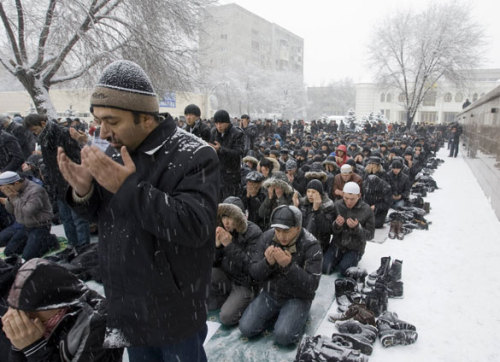
Jumu'ah in snow Kazakhstan


The boss- orders everyone around and expects to be followed, as if he's divinely ordained as the boss. He says 'Zayd sweep the prayer hall, Mo kill the coakroaches, sisters clean the kitchen'!

The old- seems to have been at university since the uni opened. He never seems to finish his PhD, or seems to do many PhDs and degrees. He says 'back in the days, I was the only Muslim, I worked hard to make this prayer hall and then you come and make it dirty!'

The charitable- seems to be involved in every charity project and initiative. Its basically his life, and he has a big heart and sincere concern. He says 'are you coming to the save the palestinians protest? The Muslims need help too! And so do the pandas, and the little muffin women, and the refugees, and the Kashmiris, and the fairies! Ah so much to do!'

The political- much concerned about the modern political climate and wants to peacefully change things. He says' the kuffar have enslaved the Muslims, we must save the Muslims, free free Muslims!'

The worshipful- whenever he is seen, he is praying. A watcher asks 'how does he still manage to come first in his class?'

The da'ee (inviter to Islam)- really enthusiastic about the religion and wants to give everyone the chance to experience the peace and beauty of Islam, and save them from hell. He says 'you can get everything you can dream and wish for, if you just obey Allah in Islam. How many brothers and sisters do you have? only 2, ah! You can have 1.3 billion!'

The superficial- focuses too much on appearance, putting lots of make up and perfume whilst neglecting purification of the heart. She says 'how do I look today? Don't I look awesome, such that you want intensify your gaze in front of me?'.  This though the Qur'an says "
Adorn not yourselves with the adornment of the Time of Ignorance." (Qur'an, 33:33)

The competitive- copies and tries to beat whatever everyone else has done. He says 'oh he climbed ben nevis? I'm going to climb 3 mountains in a day now'

The doubter- has extensive doubts about Islam and life, and tries to confuse others. People wonder why he hasn't committed suicide. He says 'there's no proof for our existence'.

The confused- doesn't know what to follow. He says 'why can't Islam be black and white, like art?  
The nasheed wannabe- tries to impress girls by forming a nasheed boy band and opting to give the adhaan in a nasheedy, beautiful voice. Randomly busts tunes when girls come, such as “you can take meee, but you can’t eat meeee, yah!”