Question:
I would like to learn the meaning of the words Mujaddid and Tajdeed.
i) How have these words been used in Hadith?
ii) Is it true that one Mujaddid will appear at the beginning of every century after Hijrah?
iii) Can there be more than one Mujaddid in a century? If yes, then, is there a pattern of
geographical dispersion of Mujaddids, or time dispersion?
iv) Can a Mujaddid be identified by common Muslim? By scholars? If yes how?
Answer:
The word Mujaddid has been derived from a well-known hadith reported by Imam Abu Dawood in his sunan, one of the six Authentic Books of Hadith. The text of the Hadith is as follows:
“Surely, Allah will send for this Ummah at the advent of every one hundred years a person (or persons) who will renovate its religion for it.” [Sunan Abu Dawood]
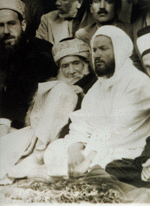 (Sheikh Badr Din Hasani, a mujaddid of 20th century)
“Surely, Allah will send for this Ummah at the advent of every one hundred years a person (or persons) who will renovate its religion for it.” [Sunan Abu Dawood]
(Sheikh Badr Din Hasani, a mujaddid of 20th century)
One of the narrators of this hadith is slightly doubtful about whether this hadith is reported by Sayyidina Abu Huraira (R) as a saying of the Holy Prophet (S) or as his own saying, though he affirms it as a saying of the Holy Prophet (S) “to the best of his knowledge”. But even if it is held to be a saying of Abu Hurairah (R) himself, he could not have predicted this happening with such certainty unless he had learnt it from the Holy Prophet (S). For this reason the scholars of hadith have taken it as an authentic hadith.
The act of “renovation of the religion” mentioned in this hadith has been referred to by the word “Tajdeed”. It means the restoration of the original beliefs and practices after their being changed, distorted or forgotten. The hadith indicates to the fact that some circles from within the Ummah may forget the original teachings of the Holy Qur’an and Sunnah, and some foreign elements may creep into the original beliefs and practices. But the distorted version of Shari‘ah, based on such foreign elements will not achieve the universal acceptance among the Muslims, and even if it succeeds in attracting a large number of people, Allah will send a person or a number of persons who will correct the error, restore the original beliefs and practices and explain the true intent of Shari‘ah. This act of renovation is called “Tajdeed”, and those who carry out this remarkable work are named as “Mujaddid” (renovator).
It is mentioned in the hadith that such people normally appear at the advent of a new century. The Arabic word used for the time of their appearance may also admit the possibility of their appearance at the end of a century, but the first meaning seems to be more probable in the context of the hadith. The word advent does not necessarily mean that they appear in the very first year of a new century. No such definite time has been given in the hadith. They can appear within the first or second decade of a century. The construction of the hadith has two possibilities with regard to the number of the renovators. There may be only one person who undertakes the task at the beginning of a century, and there may be more than one person whose efforts, as combined together, may be termed as the efforts of Tajdeed. They may work in different geographical divisions without having a formal relation between them or, possibly, without knowing each other. Still the work carried out by them can be termed as Tajdeed.
In order to avoid some dangerous misconceptions, the following points must always be kept in mind in relation to the term Mujaddid:
1. Mujaddid is not a formal designation like prophet or messenger. There is no particular authority in this world who declares him as a mujaddid. It is only through his work that he is recognized as such. This recognition also is not as certain as the recognition of a prophet. Therefore, the opinions may differ about his being a mujaddid.
2. A true mujaddid does not claim to be a mujaddid with certainty, nor does he invite others to believe in him as such.
3. Even if the majority of the Muslims is of the opinion that a particular person is a mujaddid, there is no religious obligation on the others to believe in him as a mujaddid. In other words, the recognition of a mujaddid is not a part of the necessary religious beliefs.
4. A mujaddid does not receive any authentic revelation from Allah like a prophet, nor does he make any such claim. He does not bring any new teachings regarding the religion. Rather, he tries to revive the original teachings of the Holy Qur’an and Sunnah.
5. It is not necessary that a mujaddid knows himself to be a mujaddid, let alone laying any claim to this effect.
6. A mujaddid is not infallible in his sayings and actions, [unlike] a prophet. His sayings and acts normally conform to the Islamic teachings, but they are not treated like the sayings and acts of a prophet.
Keeping these points in view, one can easily understand that a mujaddid is always identified through his work. Normally the scholars of Shari‘ah recognize him but their recognition cannot be held as certain and definite as the recognition of a prophet. There may be difference of opinion in this matter; in fact, there has been difference of opinion about the identification of mujaddids in different centuries.
[Also], the hadith quoted above, while foretelling the appearance of mujaddids in every century, does not intend to make it compulsory to recognize such mujaddids. It is rather a consolation for the Muslims of the coming generations that, despite all the distortions or innovations which may creep into the Muslim society, the ummah shall not be deprived of the pious persons who shall never be influenced by such distortions, and who shall follow the original teachings of the Holy Qur’an and Sunnah and invite the people to this respect. The Muslims of the coming generations are, therefore, directed by this hadith to follow only those persons who dwell upon the original teachings of the Holy Qur’an and Sunnah and refuse to follow the un-Islamic customs, beliefs and practices which have not been derived from these original holy resources.
Whilst the above is taken from: (http://attalib.blogspot.com/2008/11/meaning-of-word-mujaddid.html)
A good list of the mujaddids of various centuries is found at:
http://www.livingislam.org/fiqhi/fiqha_e96.html
It is important we see the list and research on the various scholars there, since we owe it to them for reviving Islam and contributing so much to Islam, and perhaps we can learn how to revive Islam now insha'Allah.


 . Many hadiths
highlight the spiritual dimension of a Muslim's life.


