One of his students related,“He would often ask us upon completion of his prayers, ‘Do you hear the reply of the Messenger of God (PBUH) during the tashahhud (recited during the sitting of the ritual prayer) when you say, al-salāmu ʿalayka ayyuha al-nabiyyu wa raḥmatullah wa barakātuhu?’ I used to ask, ‘And is there anybody who hears such a thing?’ He would respond, ‘There are people for whom if they lost their presence of heart with the Messenger of God (Peace and Blessing be Upon Him) for one moment, they would perish.’”
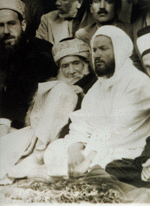
Few people have had an impact on 20th Century Muslim society as Shaykh Badr al-Dīn al-Ḥasanī. In the Levant in particular, he was unparalleled in his stature among the people of sacred knowledge and came to be considered a reviver of Islam (mujaddid) during his era. He was a man sought by poor peasants and powerful leaders alike, and to each he gave their rightful due with humility and justice. His gatherings used to be flooded with students seeking to carry on the tradition of sacred learning as well as those simple souls who desired nothing more than acquiring the blessing of being in his noble presence. It is reported that when he would pass by, people would peer out of their windows to catch a glimpse of him. Despite his esteemed rank in the eyes of people, Shaykh Badr al-Dīn remained humble and dedicated to the service of the Muslim community until the final days of his life.
His Early Life
Muḥammad Badr al-Dīn b. Yūsuf al-Marākishī al-Sibtī al-Baybānī al-Dimashqī al-Ḥasanī was born to parents of righteousness and piety. His father was Yūsuf b. Badr al-Dīn who was originally from Morroco, Mālikī in fiqh and Qādirī in tarīqa. The father of Shaykh Badr al-Dīn traveled far and wide in pursuit of sacred knowledge from the luminaries of the Muslim world of his time. He went to Egypt where he obtained a degree from al-Azhar University and studied with scholars such as ʿAbd Allāh al-Sharqāwī, Amīr al-Ṣaghīr and Shihāb al-Ṣāwī. He then traveled to the Arabian Peninsula where he took hadiths from the Madīnan hadith transmitter Zayn al-ʿĀbidīn al-Baʿlawī and the Meccan hadith transmitter ʿUmar al-ʿAṭṭār al-Makkī. Afterwards, he traveled to Damascus where he took hadiths from its renowned scholars, ʿAbd al-Raḥmān al-Kuzbarī and Shams Muḥammad b. ʿĀbidīn al-Ḥanafī al-Dimashqī. He also traveled to Baghdād where he took the Qādirī ṭarīqa from Shaykh ʿAbd al-ʿAzīz al-Qādirī. Yūsuf b. Badr al-Dīn is described as having been abundant in his recitation of the Qurʿān and constant in his sending of blessings upon the Prophet (Peace and Blessings be Upon Him). His good character was an emulation of that of the Prophet (Peace and Blessings be Upon Him) whose noble traits he had imbibed into his own nature. He was said to have feared neither elder nor leader in upholding the truth. Among his prominent students were Aḥmad b. ʿAbd al-Ghanī b. ʿĀbidīn and his son the mufti of Damascus Abū al-Khayr ʿ Ābidīn, ʿAbd al-Razzāq al-Bīṭār, and Muṣṭafa al-Khālidī. Yūsuf b. Badr al-Dīn settled in Damascus where he taught and married ʿĀʾisha bt. Ibrāhīm al-Kuzbarī.
ʿĀʾisha bt. Ibrāhīm al-Kuzbarī came from an old Damascene family known for its strong devotion to religious knowledge and piety. Many members of this family had been prominent hadith transmitters and the Kuzbarī family is accredited with having maintained the tradition of hadith transmission under the roof of their own household for 137 years, at a time when hadith transmission had become extinct in all but a few places of the world. They were also descendents of the Prophet Muḥammad through Ḥasan b. ʿAlī, thus making Shaykh Badr al-Dīn’s link to the Prophet (Peace and Blessings be Uponn Him) to be one inherited by both paternal and maternal sides of his family.
ʿĀʾisha bt. Ibrāhīm is described as an upright and God-conscious woman who avoided unclear matters out of fear of falling into what was sinful. She only had two children: Badr al-Dīn and his younger brother Aḥmad Bahāʾ al-Dīn who would grow up to be a prominent Shaykh of the Naqishbandī order in Damascus. ʿĀʾisha bt. Ibrāhīm’s devotion to God and her acute courtesy (adab) towards Him was exemplified in the manner in which she raised her children. It is narrated that when her son Badr al-Dīn was born, she used to not nurse him except in a state of ritual ablution and during Ramaḍān she did not nurse him during the daylight hours. When his father died at a young age, she remained attentive to rearing her sons with the best Islamic upbringing and it was she who ensured that Shaykh Badr al-Dīn received the best spiritual and religious education at the feet of the foremost men of God of her time.
Upon the death of his father, when Shaykh Badr al-Dīn was only 12 years of age, he secluded himself in the grand library that he had inherited and began to study its books with great interest. His mother (or his maternal uncle according to some sources) soon placed his religious instruction under the care of the notable Shaykh Abū al-Khayr al-Khaṭīb. The young Badr al-Dīn soon memorized thousands of lines of poetry (mutūn) composed on the various branches of the Islamic Sciences such as, the Alfiyya of Ibn Mālik in Arabic grammar, the Shāṭibiyya in the variant Qur’anic recitations, and the Alfiyya of al-ʿIrāqī in hadith methodology. His astonishing ability to commit to memory vast amounts of knowledge, coupled with his humility and piety piqued the interest of his teachers. He was granted a general ijāza (diploma or permission) to teach by his teachers when he was only 18 years of age.
After receiving this ijāza, he began to teach grammar and morphology at the Umayyad Mosque. Shortly thereafter, he abandoned teaching classes and went into a seclusion that lasted approximately ten years. Shaykh Badr al-Dīn spent this lengthy period engrossed in both study and worship in a cell of the old Ashrafiyya Hadith Compound near the Umayyad Mosque. He directed his attention to mastering the Hadith Sciences until he reached a level of mastery that was unparalleled by any other. He learned by heart the Muwaṭṭa and the six canonical hadith collections (al-kutub al-sitta) along with all of their chains of transmission. He also committed to memory all of the transmitters of hadiths and what was reported by hadith critics in ranking the reliability of their transmission (ʿilm al-rijāl).
When he began to near the age of 30 , Shaykh Badr al-Dīn came out of his isolation and traveled for a period to Egypt to sit at the feet of its eminent scholars. He met with al-ʿAllāma Shaykh Ibrāhīm b. ʿAlī b. Ḥasan al-Saqqa who was Egypt’s most prominent scholar of Islamic Law and was entrusted with delivering the khuṭba for al-Azhar for over 20 years. Shaykh Badr al-Dīn studied with him in al-Azhar until he obtained from him an ijāza in the year 1878. He then took hadith from the great muhaddith of Egypt al-ʿAllāma al-Shaykh Ḥasan al-ʿAdawī al-Ḥamzāwī al-Mālikī. Shaykh Ḥasan al-ʿAdawī was renowned not only for his expertise in hadith and his knowledge of the biographies of the righteous, but also for his lofty character. Among the works he authored are the famous compilation of prayers known as al-Mashāriq al-Anwār, a commentary on Imām Buṣīrī’s Burda (al-Nafaḥāt al-shādhiliyya: sharḥ al-burda), and commentary on Qāḍī ʿIyāḍ’s Shifāʾ (al-Madad al-fayyāḍ ʿalā shifāʾ al-ʿiyāḍ). Shaykh Ḥasan al-ʿAdawī was known for his generosity and concern for students of sacred learning and his continuous efforts to meet their needs and facilitate their affairs. Shaykh Badr al-Dīn learned from him and was granted an ijāza from Shaykh Ḥasan al-ʿAdawī shortly before he passed away in 1886.
His Return to Damascus
Shaykh Badr al-Dīn returned to Damascus having matured both in heart and intellect. He had become unsurpassed in his understanding of sacred knowledge and all the scholars of Greater Syria took him as their teacher. He soon married the daughter of the gnostic Muḥyiddīn al-ʿĀnī and dedicated the remainder of his life to teaching. His students would say of him that he had a photographic memory and when he would relate a hadith he would do so with its exact wording, chain of transmission, and discuss what all the commentators of the hadith said about it. In addition he would add his own commentary that included aspects of grammar, Islamic legal theory, and explanation (tafsīr). It was said that he could spend an hour discussing all of these aspects of a single hadith not only with complete ease but also doing so entirely from the vastness of his own knowledge and without reference to any of his books. He used to conduct approximately twelve different gatherings of learning in one day. He would start teaching after the dawn prayer and continue into the evening. He dedicated time to three types of gatherings. The first type of gathering was that of closed classes for advanced students who sought training in the more sophisticated classical texts of Islam. The second type were large general lessons open to the public. Erudite scholars and uneducated common folk alike would crowd these gatherings and take back whatever wisdom they acquired to their households. Finally, the Shaykh would devote a set period to answer specific questions directed at him by those who sought him out for this reason.
The subjects he taught were varied and not limited to one particular discipline. Samples of the books he taught are the Qur’anic commentaries of Bayḍāwī and Naysābūrī in tafsīr, the commentaries of al-Amīr and Bājūrī to the Jawharat al-tawḥīd in theology, Sharḥ jamʿ al-jawāmiʿ in legal methodology, the Nukhbat al-Fikr in hadith methodology, Ghazali’s Iḥyāʾ , Ibn ʿAtāʾillāh’s Ḥikam, and the Risāla of al-Qushayri in spirituality, the commentary of Qaḍī ʿIyāḍ’s Shifāʾ by Mulla ʿAlī in the Prophetic characteristics S, the Kāfiya of Ibn Ḥājib in Arabic grammar, and many others. His students used to cite that the clarity of his thought was exceptional in regards to his ability to move from one topic to another and return to his original point after many divergences without losing his train of thought. His mastery of all of the branches of Islamic sciences was also regarded as unique to his exceptional memory.
Far more importantly, he was not only a scholar of book knowledge but he was also a possessor of the experiential knowledge of God. He never lost sight that the most important aspect of teaching was the spiritual one of purifying hearts and refining spirits. He never embarrassed his students or confronted them in harshness. His students attest that he would frequently sense the states of those attending his gatherings and give appropriate words directed at their personal circumstances of which he had no knowledge of beforehand. He held that the best way to correct faults was through gentleness and good example. His students would say his spiritual upbringing of them was conducted by gaze rather than words (bi al-naẓari dūna kalām).
He also focused on the root causes of sins and diseases of the heart rather than the symptoms of deeper issues. For example, he understood that people often fall into sin due to underlying causes such as weakness or financial desperation and that dealing with such individuals with kindness and compassion was far more effective than censure. It is related that the Shaykh once sent one of his students to a depraved area of Damascus with the assignment of giving money to the leading woman of the whorehouse there and telling her that Shaykh Badr al-Dīn asks that you pray for him. When this student met the woman he was sent to, he gave her 10 gold coins and told her that this was a gift from Shaykh Badr al-Dīn and that he asks that she pray for him. The woman became so deeply moved by this gesture and ashamed that the likeness of herself be asked to pray for the likeness of the great Shaykh Badr al-Dīn that she repented and amended her ways.
His Character
Shaykh Badr al-Dīn was a man of light hair, a round face, blue eyes, and light facial hair. His face was luminous and inspired both the awe and admiration of those who saw him. He was acutely intelligent and had a phenomenal memory that was rarely encountered. His students would say of him that he could remember discrete details of events and passages from obscure texts with ease. Shaykh Badr al-Dīn spoke little. His words were mostly limited to teaching, the remembrance of God (dhikr), and sending blessings upon the Prophet (Peace and Blessings be Upon Him). He used to warn his students about the spiritual dangers of excessive speech. He never spoke ill of others and never condoned anyone else to do so in his presence. He had great fear of God and took precaution to avoid issuing legal opinions (fatwas) to those who sought this of him. He would often refer people to others who could accommodate their request.
Shaykh Badr al-Dīn was a man of intense humility. In fact, his extreme humility was one of his most distinguishing characteristics. He hated for anybody to stand for him and would refuse to ever lead the congregational prayer, instead he would have one his students lead and he would follow. He would say, “Humility is to see one’s self as inferior to all others.” If one came to him complaining about their bad character he would often say, “Thank God that you are not of the likes of me.” Shaykh Badr al-Dīn used to often say that the fastest path to God is that of humility. He frequented the company of the poor and needy. He would visit schools and prisons. He would not deter from asking questions to the teachers, speaking with students, as well as advising and consoling prisoners all the meanwhile asking each of them to pray for him before departing their company. He was generous to his guests and would spend large amounts in charity that he kept secret from all others but a few who assisted him. In accordance with the Prophetic advice, “The best of you are those who are best to their families and I am best to my family,” Shaykh Badr al-Dīn showed concern for the needs of his family and treated them with gentleness and goodness.
Shaykh Badr al-Dīn was attentive to practicing the sunna of the Prophet (Peace and Blessings be Upon Him) in all of his actions, words, and worship. When asked he would reply that the path to God is following His laws (sharīʿa) and practicing the noble sunna. He was firm in his trust in God. It has been related that once he was traveling on a train heading for Medina. It was forced to stop for maintenance purposes in the midst of a desert that had no source of water or settlement in sight. When some of the people had gotten off the train to pray in congregation, the train began to set for movement. All of the congregants abandoned the prayer and rushed onto the train except for Shaykh Badr al-Dīn. Once the train had started the conductor was notified that the Shaykh had not aboarded, the train returned back to its original position to find Shaykh Badr al-Dīn in the final sitting of the prayer. The train waited for him to complete his prayer and thereupon he boarded. He had not feared being abandoned in the desert. He was vigilant about the cleanliness of his clothes, food, and his home and taught his family the same. He was a man who always maintained a cheerful face and smiled continuously.
His Worship
Men and women of sacred wisdom have continually recognized that the key to curing hearts is not found through the possession of knowledge alone, but also with its accompaniment with a large quantity of worship. We see a model of this understanding in the person of Shaykh Badr al-Dīn, who complemented his instruction with a persistent schedule of extensive worship. He used to sleep for a short period in the early evening, often upright and leaning upon something so as to not be overcome by excessive slumber. He would then get up for tahajjud and pray until the dawn had neared, upon which he would walk to the Umayyad Mosque. It is stated in the Qur’an, “And part of the night, rise in superogatory [devotion] for you, that your Lord may grant you a praiseworty station (Qur’an, 17:79).” As generations of men and women of God both past and present, Shaykh Badr al-Dīn regarded the hours spent in worship at night to be an obligation and prerequisite for all who possess lofty aspirations.
Once in the mosque, he would take a place in the first row of worshippers and pray the prayer of greeting to the mosque. He would then wait for the congregation and pray the dawn prayer with them, after which Shaykh Badr al-Dīn would retire to an area of seclusion and do his litanies (awrād) until the sun rose. He would then pray the ḍuḥā prayer. His students said of him that he had never missed this prayer, not even when he was on pilgrimage. Upon the completion of the ḍuḥā prayer, he would begin his schedule of classes that would continue until shortly before noon at which he would renew ablutions and have a lengthy period of superogatory prayers and litanies (awrād) until the congregation for the noon prayer would gather. Out of humility, he would always refuse to lead the prayer. This would be the likeness of the Shaykh’s schedule for the rest of his day. He would constantly have remembrances (adhkār) from the sunna of the Prophet that he would read after each prayer. He used to fast extensively and break the fast only periodically in order to avoid being of those who kept the discouraged continuous daily fast (ṣiyām al-dahr). He used to go into seclusion for three months of every year; Rajab, Shaʿbān, and Ramaḍān. His entire day was spent in worship, service, and the remembrance of God without intermission. He went on pilgrimage twice, once in 1901 and another in 1914.
His Intellectual Legacy
Shaykh Badr al-Dīn al-Ḥasanī composed about forty works. Most of these were compiled during the initial period of his life, which he spent in study and worship. The majority of them still remain in manuscript form and await editing. Shaykh Badr al-Dīn’s intellectual legacy, which he imparted upon his students by teaching what he composed, played an essential role in the continuation and dissemination of the Islamic intellectual heritage at a time of decline in Muslim scholarship. Among the many works of Shaykh Badr al-Dīn al-Ḥasanī are; Ḥāshiya ʿalā tafsīr al-jalālayn (Qur’anic commentary), al-Durar al-bahiyya fī sharḥ al-manẓūma al-bayqūniyya (hadith sciences), Sharḥ qasīdat al-gharāmiyya fī al-muṣṭalaḥ al-ḥadīth (hadith sciences), Rawḍ al-maʿānī li-sharḥ ʿaqīdat al-ʿallāma al-Shaybānī (theology), al-Yāqūt al-wafiyya: ḥāshiya ʿalā sharḥ al-raḥbiyya (Muslim inheritance law), Ghāyat al-marām ʿalā sharḥ al-qaṭr li-Ibn Hishām (Arabic grammar), and al-Anwār al-jaliyya fī ḥawāshī sharḥ burdat madīh sayyid al-bariyya (commentary on the poem of the Burda praising the Prophet S). Shaykh Badr al-Dīn al-Ḥasanī was sought out not only by students in his surrounding area of the Levant, but he had seekers of knowledge who came from parts of the world such as Yemen, Mecca, Medina, Istanbul, and Central Asia to take from him the classical texts which he had mastered. When he went on the pilgrimage, it is related that he was received with great enthusiasm by the scholars, pilgrims, and inhabitants of Mecca and Medina. He conducted many gatherings and granted many ijāzas during this period to Muslims from diverse parts of the world. It is noted in historical biographies that there was a particularly significant number of scholars from India at this time who took hadiths from Shaykh Badr al-Dīn al-Ḥasanī and continued their transmission in their homeland.
His Role during Ottoman Rule and French Colonization
Shaykh Badr al-Dīn was highly regarded by the rulers and officials of the late Ottoman Empire who would often seek his approval for their policies in Greater Syria or ask for his blessings. Shaykh Badr al-Dīn would never seek out the heads of government but they would often call upon him themselves. During the period of turmoil in Greater Syria due to the harsh policies of the Ittihad ve Terakki government, Shaykh Badr al-Dīn opposed the ideas of a revolt that had become a popular topic of debate in some circles. Rather, he confronted the political elite with words of counsel and appropriate criticism.
After the disintegration of the final Muslim caliphate and the beginning of the French occupation of Syria, Shaykh Badr al-Dīn al-Ḥasānī was a key figure in the resistance against colonization. He traveled to cities throughout Syria to promote the resistance and issued a legal opinion (fatwa) that joining the opposition was an obligation (wājib) upon all men who had the physical capacity to do so. The affection that the people had for Shaykh Badr al-Dīn was an important factor in his ability to persuade them to join the ranks of the fighters against the French. While too old to fight himself, he energized the revolt against the French colonizers through the focused attention (tawajjuh) he gave to its leading fighters, electrifying their hearts with the power to resist the muscle of heartless technological supremacy. It is reported that two of the most important leaders against the French, Muḥammad al-Aḥmar and Ḥasan al-Kharrāṭ, used to meet with the Shaykh regularly before the dawn prayer and gain spiritual strength, courage, and counsel through his company.
His Impact
The impact of Shaykh Badr al-Dīn al-Ḥasanī upon the Muslim world is acutely felt through the students he left behind. The students he trained played pivotal roles in establishing the most important institutions of Islamic learning in Greater Syria that continue to attract students from all corners of the world today. Some of his students were, Shaykh Ḥasan Ḥabannaka who established a college of Islamic Sciences in the Mīdān area of Damascus from which many imams and religious teachers graduated. Among the most famous students of Shaykh Ḥasan Ḥabannaka are Shaykh Saʿīd Ramaḍān al-Būṭī and Shaykh Musṭafa al-Bughā. Another student of Shaykh Badr al-Dīn was ʿAbd al-Karīm al-Rifāʿī who established the mosque of Zayd b. Thābit in the Bāb al-Sarīja section of Damascus. In this mosque, Shaykh ʿAbd al-Karīm al-Rifāʿī trained many of Syria’s leading reciters of the Qur’an (qurrāʾ) including its most eminent scholar and reciter known as the shaykh al-qurrāʾ (or the leading reciter of all of the Qur’an reciters of Greater Syria), the late Shaykh Abū al-Ḥasan Muḥyi al-Dīn al-Kurdī from whom thousands of men and women have received ijāzas in Qur’anic recitation.
Shaykh Muḥammad Ṣāliḥ al-Farfūr is yet another student of Shaykh Badr al-Dīn who established the Fatiḥ al-Islāmī institute that hosts some of the most important scholars of Syria and attracts a large number of students from foreign countries. Shaykh Badr al-Dīn al-ʿĀbidīn was another student who established the Badr al-Dīn al-Ḥasanī Foundation for Sacred Sciences offering both high school and college training to a similarly diverse range of students.
Shaykh Badr al-Dīn had only one brother, Shaykh Aḥmad Bahāʾ al-Dīn, who took the Naqishbandī ṭarīqa and focused on his duties as on one of its leading figures in Damascus. He was deeply devoted to his older brother and assisted Shaykh Badr al-Dīn in many of his personal affairs. Shaykh Badr al-Dīn also had two sons and six daughters. Two of his daughters in particular, became distinguished for their great piety and experiential knowledge of God. The older of the two was the late Hājja Bahiyya. She was a woman of sharp intellect and she never married. She devoted herself to worship early on in her life. Hājja Bahiyya lived a life of intense abstinence from worldly comforts. Her food and clothes were simple and she would spend the time of the night vigil (tahajjud) until the time of sunrise in superogatory worship. She also had many litanies (awrād) that she would recite regularly. She gave particular attention to reciting the verse of the throne (ayat al-kursī) a thousand times each day as well as doing the litanies of the Latifiyya (repetition of “Yā Laṭīf”) and the Basmala (repetion of “bismillāh al-raḥmān al-raḥīm) regularly. Hājja Bahiyya also had many sūras from the Qur’an she would recite daily and she paid special attention to the recitation of the chapters of Yāsīn and Anʿām. She would also read the Burda every Monday of the week and would often read the Dalāʾil al-khayrāt of Imam al-Jāzūlī.She became a specialist of the sciences of the heart and was sought after by some of the most prominent Shaykhs to reveal their innermost flaws. She used to give much in charity. Ḥājja Bahiyya was known as being sincere and candid in her interactions with people.She was also abundantly kind and would forgive anyone who wronged her. She used to say, “I cannot harm one who has harmed me.” Hājja Bahiyya’s states were often not comprehended by those around her but her father used to understand her and show great compassion towards her. When her father died, she moved to a room attached to his tomb by the mosque compound. She spent the remainder of her life there absorbed in worship until she passed away in 1967 and was buried beside her father. Her sister Sarah was said to also have been a woman of intense piety and gnosis, though not as austere as Hājja Bahiyya. Their impact upon the women who came in contact with them was significant and extended beyond their own lifetimes.
Lessons from His Life
1) In the life of Shaykh Badr al-Dīn, we see a model of unwavering steadfastness in the face of immense challenges. He witnessed not only the fall of Muslim rule after around 1300 years of supremacy, but the defeat of much of the Muslim world and its occupation by European colonialists for the first time since Islam’s inception. In addition, missionary activity had become widespread in the Muslim world and a fascination with European lifestyles was the emergent trend of his day. The strength with which the Shaykh confronted this period of turmoil is a source of inspiration to later generations.
2) He secluded himself for a period in the beginning of his life, devoting this time to worship and study. Ibn ʿAṭāʾillāh says, “Bury your existence in the earth of obscurity, for whatever sprouts forth, without having first been buried, flowers imperfectly.” This wisdom has commonly been interpreted as emphasizing the dangers of the assumption of leadership roles without the adequate spiritual training that must precede. Shaykh Badr al-Dīn spent an extended period of time in preparation for his important future work.
3) In Shaykh Badr al-Dīn, we find a scholar who not only mastered all of the exoteric sciences of Islam, but also balanced this with the understanding of the esoteric sciences of the heart. He was a luminary of both heart and intellect. He understood that knowledge, which does not accompany the purification of the heart and an increase in one’s proximity to God is of no value.
4) Shaykh Badr al-Dīn was a scholar who practiced what he preached. He maintained a life of discipline and strict adherence to God’s laws without allowing himself dispensations or slackening in his practice of Islam.
5) He was a scholar who did not live in isolation from the common citizens. Shaykh Badr al-Dīn was acutely in tune with the unique circumstances of his contemporary society. He was esteemed by both the educated strata who admired him for his understanding of worldly affairs and sharp intellect as well as the simple folk who loved him for his piety and lofty character. He gave legal opinions that neither compromised divine injunctions nor burdened the Muslims with rulings that contradicted the necessities of the conditions in which they lived.
6) He was vigilant about guarding over his heart and making sure that all of his actions were done sincerely for the sake of God and without ulterior motives. He never set out to do good works except that he would expend great effort to conceal it out of fear of desiring recognition or veneration.
7) He avoided worldly comforts and chose a life of simplicity (zuhd) at a time when those around him were distracted with the accumulation of wealth. He took only what he needed from the world and devoted the greater part of his life to the superior ambition of imparting the teachings of Islam to future generations. Indeed, all of Greater Syria has thrived for over one hundred years on the intellectual and spiritual legacy of its great Shaykh and the prominent students he trained.
Taken from:
http://www.nursacredsciences.com/the-legacy-of-al-muhaddith-al-akbar-shaykh-badr-al-din-al-hasani/


 . Many hadiths
highlight the spiritual dimension of a Muslim's life.